
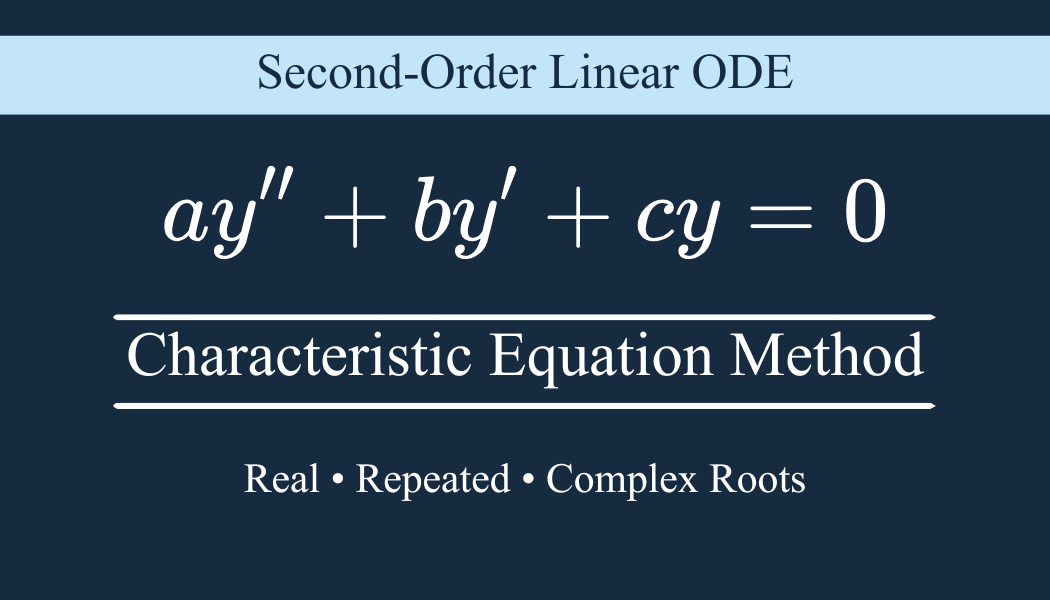
Second-order linear differential equations with constant coefficients appear throughout engineering and applied mathematics, including mechanical vibrations, electrical circuits (RLC systems), structural analysis, and control systems.
The central tool for solving these equations is the characteristic equation, which transforms the differential equation into an algebraic problem.
Prefer structured video lessons? Follow the full sequence in this Ordinary Differential Equations playlist.
For organized notes, visit the Ordinary Differential Equations resource page.
This guide explains the method clearly and systematically.
How to Solve These Equations (Quick Reference)
If you are given:
ay″ + by′ + cy = 0
Form the characteristic equation:
am² + bm + c = 0Compute the discriminant:
Δ = b² − 4acUse Δ to determine the solution form:
Once the roots are classified correctly, the structure of the solution follows immediately.
What Is a Second-Order Homogeneous Linear Differential Equation?
A differential equation of the form
ay″ + by′ + cy = 0
where a, b, c ∈ ℝ and a ≠ 0
is called:
Second order because the highest derivative is y″
Linear because y, y′, and y″ appear only to the first power
Homogeneous because the right-hand side equals zero
With constant coefficients because a, b, and c are constants
Why the Characteristic Equation Works
Suppose we try a solution of the form:
y = e^(mx)
Then:
y′ = me^(mx)
y″ = m²e^(mx)
Substituting into
ay″ + by′ + cy = 0
gives:
(am² + bm + c)e^(mx) = 0
Since e^(mx) ≠ 0, the equation reduces to:
am² + bm + c = 0
This quadratic equation is called the characteristic equation.
Its roots determine the form of the solution.
Step 1 — Form the Characteristic Equation
Assume:
y = e^(mx)
Substitute into the differential equation and simplify to obtain:
am² + bm + c = 0
This algebraic equation forms the foundation of the solution method.
Step 2 — Classify the Roots and Write the General Solution
Use the quadratic formula:
m = (-b ± √(b² − 4ac)) / (2a)
Let Δ = b² − 4ac.
Case 1: Two Distinct Real Roots (Δ > 0)
If the roots are m₁ and m₂, then the general solution is:
y = C₁e^(m₁x) + C₂e^(m₂x)
Example
y″ − y′ − 6y = 0
Characteristic equation:
m² − m − 6 = 0
(m + 2)(m − 3) = 0
Roots:
m = −2, 3
Solution:
y = C₁e^(−2x) + C₂e^(3x)
When Δ > 0, the solution consists entirely of exponential growth or decay terms.
Case 2: One Repeated Root (Δ = 0)
If the characteristic equation has a repeated real root m, the solution becomes:
y = C₁e^(mx) + C₂xe^(mx)
The factor of x ensures the two solutions are linearly independent.
Example
y″ − 10y′ + 25y = 0
Characteristic equation:
(m − 5)² = 0
Root:
m = 5
Solution:
y = C₁e^(5x) + C₂xe^(5x)
Case 3: Complex Conjugate Roots (Δ < 0)
If the roots are:
m = α ± βi
the real-valued solution is:
y = e^(αx)(C₁cos βx + C₂sin βx)
Example
y″ − 6y′ + 13y = 0
Characteristic equation:
m² − 6m + 13 = 0
Roots:
m = 3 ± 2i
Solution:
y = e^(3x)(C₁cos 2x + C₂sin 2x)
When Δ < 0, the solution exhibits oscillatory behavior combined with exponential growth or decay.
Solving Initial Value Problems (IVPs)
An initial value problem specifies conditions such as:
y(0) = value
y′(0) = value
These determine the constants C₁ and C₂.
Example
y″ + 16y = 0
y(0) = 2
y′(0) = −1
Characteristic equation:
m² + 16 = 0
m = ±4i
General solution:
y = C₁cos 4x + C₂sin 4x
Applying the initial conditions:
C₁ = 2
C₂ = −1/4
Final solution:
y = 2cos 4x − (1/4)sin 4x
Solving Boundary Value Problems (BVPs)
A boundary value problem specifies conditions at two different points.
Example
y″ + 8y′ + 16y = 0
y(0) = 1
y(1) = 0
Characteristic equation:
(m + 4)² = 0
Root:
m = −4
General solution:
y = C₁e^(−4x) + C₂xe^(−4x)
Applying the boundary conditions:
C₁ = 1
C₂ = −1
Final solution:
y = (1 − x)e^(−4x)
Non-Homogeneous Equations (Overview)
If the equation has the form
ay″ + by′ + cy = g(x)
the solution is written as:
y = yₕ + yₚ
where:
yₕ is the homogeneous solution
yₚ is a particular solution that depends on g(x)
Two common methods are:
Method of Undetermined Coefficients, used when g(x) is a polynomial, exponential, sine/cosine function, or combinations of these.
Variation of Parameters, a general method applicable to broader forcing functions.
Common Mistakes
Forgetting the extra x in the repeated root case
Misclassifying the discriminant
Overlapping the trial solution in undetermined coefficients
Dropping constants or misapplying signs
Failing to verify independence of solutions
Extending to Higher-Order Equations
For equations such as
aₙy^(n) + aₙ₋₁y^(n−1) + … + a₁y′ + a₀y = 0
form the characteristic polynomial, find its roots (including multiplicities), and build the solution using:
exponentials for real roots
x-multipliers for repeated roots
sine and cosine for complex roots
Example
y‴ − 4y″ − 5y′ = 0
Characteristic equation:
m(m − 5)(m + 1) = 0
Solution:
y = C₁ + C₂e^(5x) + C₃e^(−x)
Continue Learning
Full Ordinary Differential Equations playlist
Structured notes
How to Solve Second-Order Linear Differential Equations with Constant Coefficients (Step-by-Step)
| Discriminant | Roots | General Solution |
|---|---|---|
| Δ > 0 | Two distinct real roots m₁, m₂ | y = C₁e^(m₁x) + C₂e^(m₂x) |
| Δ = 0 | One repeated real root m | y = C₁e^(mx) + C₂xe^(mx) |
| Δ < 0 | Complex roots α ± βi | y = e^(αx)(C₁cos(βx) + C₂sin(βx)) |