How to Do Implicit Differentiation: Steps, Examples, and When to Use It
When students first learn implicit differentiation, they almost always ask the same question:
"Why don't we just solve for y first?"
It's a reasonable question—and sometimes you can.
But many equations become difficult, messy, or even impossible to rewrite in the form y = f(x). Fortunately, there is another approach. We differentiate both sides of the equation with respect to x, treating y as a function of x.
This technique is called implicit differentiation, and it's one of the most useful tools you'll learn in Calculus I. In this article, we'll look at what implicit differentiation is, why it works, and where you'll use it. If you'd like to see complete worked examples, be sure to watch the full video lesson and download the free guided notes at the end of this page.
Explicit Functions vs. Implicitly Defined Equations
Before learning implicit differentiation, it's helpful to understand the difference between functions that are defined explicitly and those that are defined implicitly.
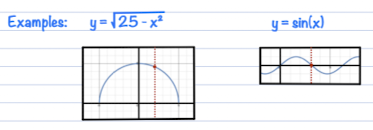
Most of the functions you encounter early in calculus are explicit functions. In an explicit function, y is already written as a function of x. For example,
y = √(25 − x²)
y = sin(x)
Since y is already isolated, we can differentiate these functions using the rules you've already learned.
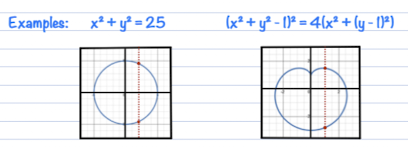
Sometimes, however, the relationship between x and y is given by a single equation instead. Examples include
x² + y² = 25
(x² + y² − 1)² = 4(x² + (y − 1)²)
Rather than solving these equations for y, implicit differentiation allows us to find dy/dx directly from the equation itself.
Why Not Just Solve for y?
Whenever possible, it's worth asking whether solving for y is actually the easiest approach.
For a simple equation like x² + y² = 25, you certainly can solve for y first and then differentiate. In fact, either approach will give the same result.
However, as equations become more complicated, solving for y can require a great deal of algebra—or it may not be practical at all.
Implicit differentiation allows us to find derivatives without first expressing the relationship as y = f(x). For many equations, this is the simpler and more efficient approach.
Where Does dy/dx Come From?
This is probably the question students ask most often.
At first, it seems like dy/dx suddenly appears out of nowhere.
It doesn't.
The reason is the Chain Rule.
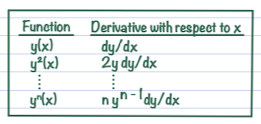
Although we usually write the variable as simply y, we should really think of it as y(x)—a function of x. Every time we differentiate a term containing y, we're differentiating a function of x. The Chain Rule tells us that every one of those derivatives must include a factor of dy/dx.
For example, when differentiating y³, we treat y as a function of x. Applying the Chain Rule gives
d/dx(y³) = 3y² · dy/dx.
The factor dy/dx isn't something we add afterward—it appears naturally because y depends on x.
Once you understand this idea, the formulas in the table below become much more natural instead of something that has to be memorized.
Is Implicit Differentiation Difficult?
Students sometimes expect implicit differentiation to be an entirely new type of calculus.
In reality, only one new idea is being introduced: remembering that y depends on x. Once you've accounted for that by using the Chain Rule, the remaining steps are very similar from one problem to the next.
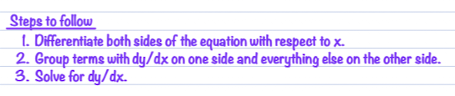
The process is summarized in the following three-step procedure.
After you've worked through a few examples, you'll find that most implicit differentiation problems follow this same pattern.
A Professor's Tip
One mistake I've seen many students make over the years is trying to solve every equation for y before differentiating.
Sometimes that works.
Often it creates much more algebra than necessary.
As you continue studying calculus, try asking yourself this question before you begin:
"Would it be easier to differentiate the equation as it is?"
If the equation naturally involves both x and y, implicit differentiation is often the simpler and more efficient approach.
Developing that instinct is just as important as learning the mechanics of the technique.
Where Will You Use Implicit Differentiation?
Implicit differentiation isn't just a single topic in Calculus I. You'll use it throughout the course and again in later mathematics.
Some common applications include:
Finding the slope of a tangent line
Finding the equation of a tangent or normal line
Solving related rates problems
Finding second derivatives
Working with curves that cannot easily be written in the form y = f(x)
Learning this technique now will make many later topics much easier.
Watch the Complete Lesson
This article introduces the ideas behind implicit differentiation. In the complete video lesson, I work through a variety of examples step by step, including equations involving radicals, trigonometric functions, products, quotients, tangent lines, and second derivatives.
Download the Free Guided Notes
Follow along with the lesson using the free guided notes. They include the key definitions, formulas, and structured note-taking pages used throughout the lesson so you can focus on understanding the concepts while watching the video.